The Saint Louis Zoo has welcomed 34 endangered humped tree snails (Partula gibba) following an emergency rescue effort in early July coordinated with the U.S. Fish and Wildlife Service, Hawaii Snail Extinction Prevention Program (SEPP), United States Marine Corps and University of Guam ahead of category five Super Typhoon Bavi.
The rescued snails are settling in at the Zoo's Bayer Insectarium, where they will be cared for under the Saint Louis Zoo WildCare Institute Partula Snail Program, which works to protect some of the world’s rarest tree snails through species recovery efforts, field conservation and managing assurance populations in human care.
These are the first-ever humped tree snails to make their home at the Saint Louis Zoo and the first time Partula gibba have come under professional care at an Association of Zoo’s and Aquarium (AZA)-accredited institution. The rescue is an incredible milestone for the endangered species, which exists in only a few small, isolated groups across Guam and the Commonwealth of the Northern Mariana Islands (CNMI).
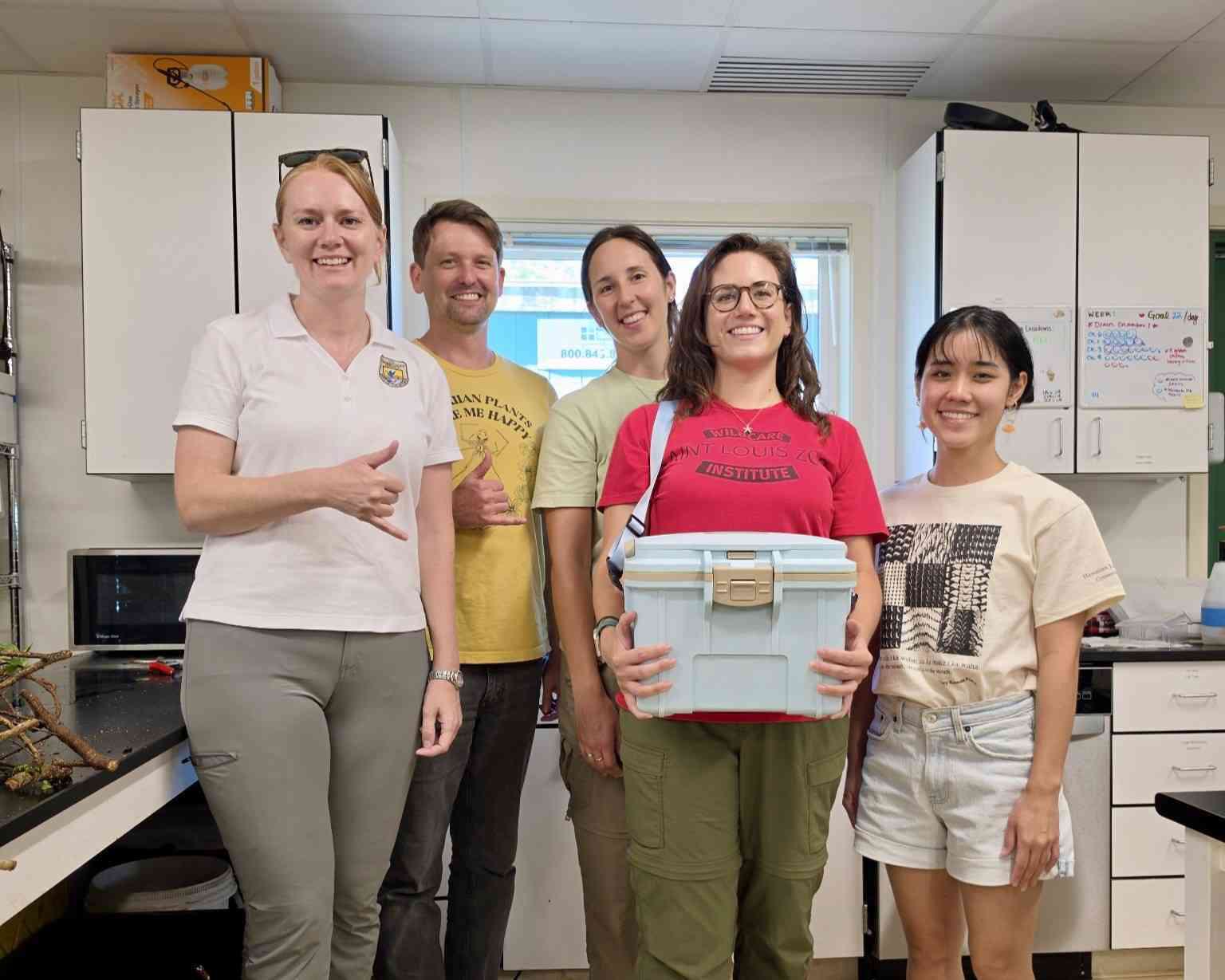
“This recovery would not be possible without the support and dedication of our partners every step of the way,” said Kayla Garcia, Saint Louis Zoo Zoological Manager of Invertebrates. “Moments like this reinforce how critical it is to work together for the species that need us.”
Tropical cyclones, known as typhoons in the western Pacific Ocean, have increased in frequency and intensity in recent decades, causing widespread damage to forest habitats and infrastructure throughout Guam and the CNMI. Typhoon Sinlaku left considerable damage across the region in April 2026, making ecosystems and communities especially vulnerable to Super Typhoon Bavi just months later.
As Super Typhoon Bavi intensified in early July, the Zoo and its partners mobilized to protect one of the last remaining populations of endangered humped tree snails.
On Friday, July 3, Dr. Curt Fiedler and his team of biologists at the University of Guam College of Natural & Applied Sciences collaborated with the U.S. Marine Corps to collect dozens of humped tree snails from one of the last known populations at Marine Corps Base Camp Blaz in Dededo, Guam. Fiedler’s team has monitored Partula gibba populations for several years, funded by Naval Facilities Engineering Systems Command (NAVFAC) Marianas. After seeing the significant impacts of Typhoon Sinlaku in April, Fiedler’s team determined that a second major storm could further decimate the population already struggling to recover.
“Sinlaku destroyed the canopy for the two known remaining subpopulations in Guam, and microhabitat conditions were extraordinarily harsh,” said Dr. Fiedler. “In the aftermath, one subpopulation was apparently wiped out, and the other was down to tens of individuals. We felt that a similar storm event hitting Guam could result in all Partula gibba being extirpated.”
To preserve the remaining population, Fielder and his team worked within a narrow window to locate and collect the remaining snails before Base Camp Blaz went under lockdown for Typhoon Bavi’s expected arrival on July 6.

From there, the snails were transported to Hawaii by U.S. Fish and Wildlife Service staff evacuating the island. The Hawaii Snail Extinction Prevention Program coordinates breeding and reintroduction for 40 snail species exclusive to Hawaii, making the SEPP lab in Honolulu uniquely suited to temporarily care for the Partula gibba while Zoo partners made the journey to collect them.
“The rapid coordination of so many partners across the globe is a hopeful example of how critically imperiled species can be saved from extinction, even under extreme circumstances,” said David Sischo, Wildlife Biologist for the State of Hawaii Department of Land and Natural Resources. “Our team in Hawaiʻi was honored to play a small role in helping usher these remarkable snails to safety. We hope the next time they pass through Hawaiʻi, it will be on their journey home for reintroduction.”
When Garcia arrived in Honolulu to accompany the snails on the final leg of their journey, she discovered that eight baby snails had been born during the layover. U.S. Fish and Wildlife Service staff escorted Garcia and the snails to their final flight, which delivered all 34 individuals to the Saint Louis Zoo on Friday, July 17.
For decades, the Saint Louis Zoo has played a leading role in international efforts to conserve Partula tree snails. The Zoo has cared for Partula nodosa since the early 1990s and continues to support global breeding and recovery initiatives for snail species facing extinction.
The newly arrived humped tree snails are settling into a specialized incubator habitat behind the scenes at the Bayer Insectarium, which replicates the temperature and humidity conditions of their native Guam. Zoo staff will closely monitor the snails and support breeding efforts aimed at establishing a healthy assurance population in human care. The long-term goal is to strengthen the species' future and support conservation efforts that may one day help restore wild populations in their native range.
While the rescued snails are now safe in human care, the impacts of Super Typhoon Bavi continue to affect communities across Guam, the Northern Mariana Islands and globally. We are grateful to our regional partners providing support for both local communities and native wildlife in the wake of the storm.
About the Humped Tree Snail
The humped tree snail (Partula gibba) was once widespread across Guam and the Commonwealth of the Northern Mariana Islands. This and other Partula species play an important role in forest health, eating the bacteria and fungi that naturally grow on both living plants and decaying vegetation. Their grazing helps control plant diseases and cycle nutrients back into the ecosystem.
Today, habitat loss, invasive predators and increasingly severe tropical storms have pushed the species to the brink of extinction. Introduced rats, predatory snails, flatworms and the brown tree snake have contributed to the decline of native wildlife throughout the Mariana Islands, including vulnerable species such as the humped tree snail.