
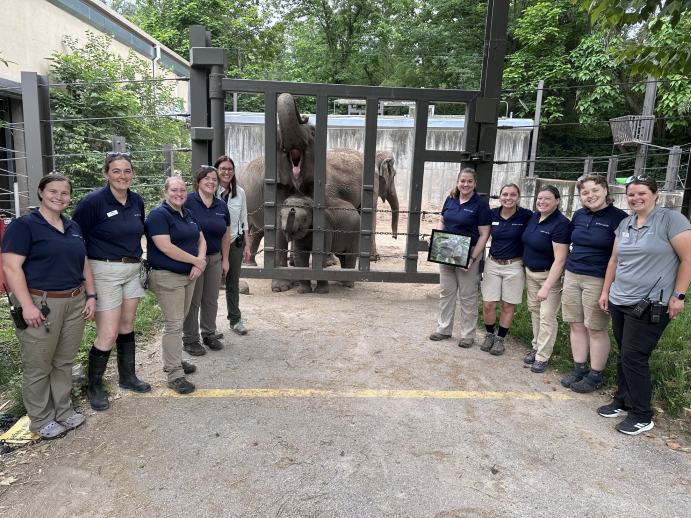
One-½-year-old Asian elephant calf Jet is the first Saint Louis Zoo elephant to receive a breakthrough mRNA vaccine for elephant endotheliotropic herpesvirus (EEHV), a deadly disease threatening elephants in the wild and in human care. Jet received the third dose of a multi-round vaccine on Wednesday, Sept. 30.
“This vaccination is a critical step forward in the decades-long effort to protect Asian elephants from EEHV," said Dr. Kari Musgrave, Director of Animal Health. "After years of collaboration with researchers, veterinarians and elephant care experts, we're thrilled to have Jet vaccinated against this devastating disease."
Jet is one of the world’s first Asian elephant calves to receive the vaccine developed by virologists at Baylor College of Medicine (BCM). He is doing well post-vaccination.
For the Saint Louis Zoo, the milestone is especially meaningful. Six-year-old Zoo resident Asian elephant Kenzi died of EEHV in 2018—the only Saint Louis Zoo elephant to pass away from the disease.
"Our team understands just how devastating EEHV can be," said Katie Pilgram-Kloppe, Curator of Ungulates and River's Edge. "I can't describe how it feels to know that Jet has an extra layer of protection against the virus that has threatened his species for decades."
Jet currently has maternal antibodies, but they will steadily decline in the next year or two. This vaccine will provide additional protection until he has natural exposure to the virus and elicits his own immune response. The Zoo’s Animal Care and Veterinary teams will continue to closely monitor Jet and regularly assess his post-vaccination antibody levels through blood testing.
EEHV and the mRNA Vaccine
Discovered in 1995, EEHV is a viral infection affecting both wild elephants and elephants in human care. Young elephant calves are especially vulnerable, facing a 60-80% mortality rate.
To address this threat, researchers at BCM and veterinarians from Houston Zoo began developing an mRNA EEHV vaccine in 2009. Adult elephants at the Houston Zoo received the first doses in 2024, and zoos throughout North America have adopted the vaccine on an experimental basis over the past two years.
Early studies have shown strong immune responses in vaccinated elephants. Researchers recently reported the first evidence of clinical protection when two vaccinated juveniles experienced a natural EEHV 1A infection and successfully recovered without medical intervention.
Leading the Fight Against EEHV
The Saint Louis Zoo has been a leader in pursuing EEHV detection and testing protocols. In 2021, the Zoo joined together with other North American elephant facilities to actively support EEHV research efforts with its own Polymerase Chain Reaction Laboratory, which allows the Zoo to test elephant blood samples within hours of collection.
The Zoo's Animal Care and Animal Health teams also contribute to blood cross-matching, antiviral treatment research and other collaborative efforts to protect the Asian elephant population in AZA-accredited, North American zoos. The Saint Louis Zoo Animal Health team maintains a plasma bank that can be used to help treat EEHV cases at zoological institutions across the country.
Asian Elephant Care at the Saint Louis Zoo
Born Nov. 23, 2024, Jet is the first Asian elephant born through artificial insemination at the Saint Louis Zoo. His mother, Zoo resident Jade, and father, Jake of the Denver Zoo Conservation Alliance, were paired together on a breeding recommendation from the AZA Asian Elephant Species Survival Plan (SSP). Breeding through voluntary artificial insemination allowed Jade to contribute to the genetic diversity of the population while remaining with her family group here at the Zoo.
Jet is the latest addition to an eight-member, four-generation elephant family at the Saint Louis Zoo, including his mother Jade and Zoo residents Ellie, Maliha, Pearl, Priya, Sri and Raja.
The AZA Asian Elephant SSP is a national cooperative breeding and management program responsible for maintaining a genetically healthy and sustainable population of Asian elephants in North American zoos. The Saint Louis Zoo also supports Asian elephant conservation through participation in the AZA Saving Animals From Extinction (SAFE) Asian Elephant Program, and the Saint Louis Zoo WildCare Institute Center for Asian Elephant Conservation supports the welfare and conservation of Asian elephants in Laos, Sumatra and other Asian countries.